The Smart Resume

User Research • Design Thinking • Product Design
Smart Resume is a key part of Geektrust’s AI hiring ecosystem- an AI powered resume format that transforms a developer’s skills, performance, and potential into a dynamic, data-backed profile helping recruiters identify real talent faster.
Project overview
Smart Resume was designed to bridge the gap between what developers claim and what they can truly do. As part of Geektrust’s AI hiring ecosystem, the goal was to reimagine the traditional resume into a data-backed, skill-first profile that recruiters could trust at a glance.

I led the design to translate complex AI insights like coding performance and interview outcomes into a format that was both scannable and credible. The idea emerged when we saw how much time recruiters spent decoding inconsistent resumes, and how a standardized, intelligent one could make hiring faster, fairer, and more confident.
MY ROLE
Responsible for research, concept creation, visual design, delivery of key modules and feature areas, user testing .
TEAM
Individual designer (reported to the Product manager) 1 PM, 3 developers.
TIMELINE
4 months
Oct 2023 - Jan 2024
🔰  40%
Faster evaluation time
Screening time dropped from an average of 10 minutes to 6, helping recruiters make quicker, informed decisions.
🔰  3x
Increase in recruiter engagement
Recruiters explored and compared candidate profiles more effectively through structured data and smart insights.
🔰  25%
Rise in shortlisting rates
Clearer data presentation improved confidence in candidate evaluation, leading to faster hiring decisions.
How does the resume fit in the hiring process?
Below is a user story explaining how the smart resume works.
How it started
Where it all began
When we set out to design the Geektrust AI Hiring Ecosystem, our goal wasn’t just to automate hiring, it was to rethink how talent gets discovered.

Early on, we noticed a major gap right at the start: the resume. Traditional resumes were inconsistent, subjective, and rarely reflected a developer’s true skills. Recruiters spent hours interpreting them, Recruiters spent hours decoding them, while great candidates went unnoticed, often because they didn’t tailor their resumes to each job role, even when they were a perfect fit.

That insight led to Smart Resume.
Spotting What's broken
Problem Statement
The hiring process is broken. Not because of a lack of talent, but because of how talent is being represented.
Company Side
Recruiters spend hours scanning through hundreds of resumes every day, trying to spot the right fit. Each profile takes 4–5 minutes to review, yet the chances of finding a perfect match remain low. Hiring managers often reject profiles that recruiters forward, creating loops of rework and wasted effort.

Without a standardized format, reviewing resumes becomes an exercise in endurance rather than evaluation.
Candidate Side
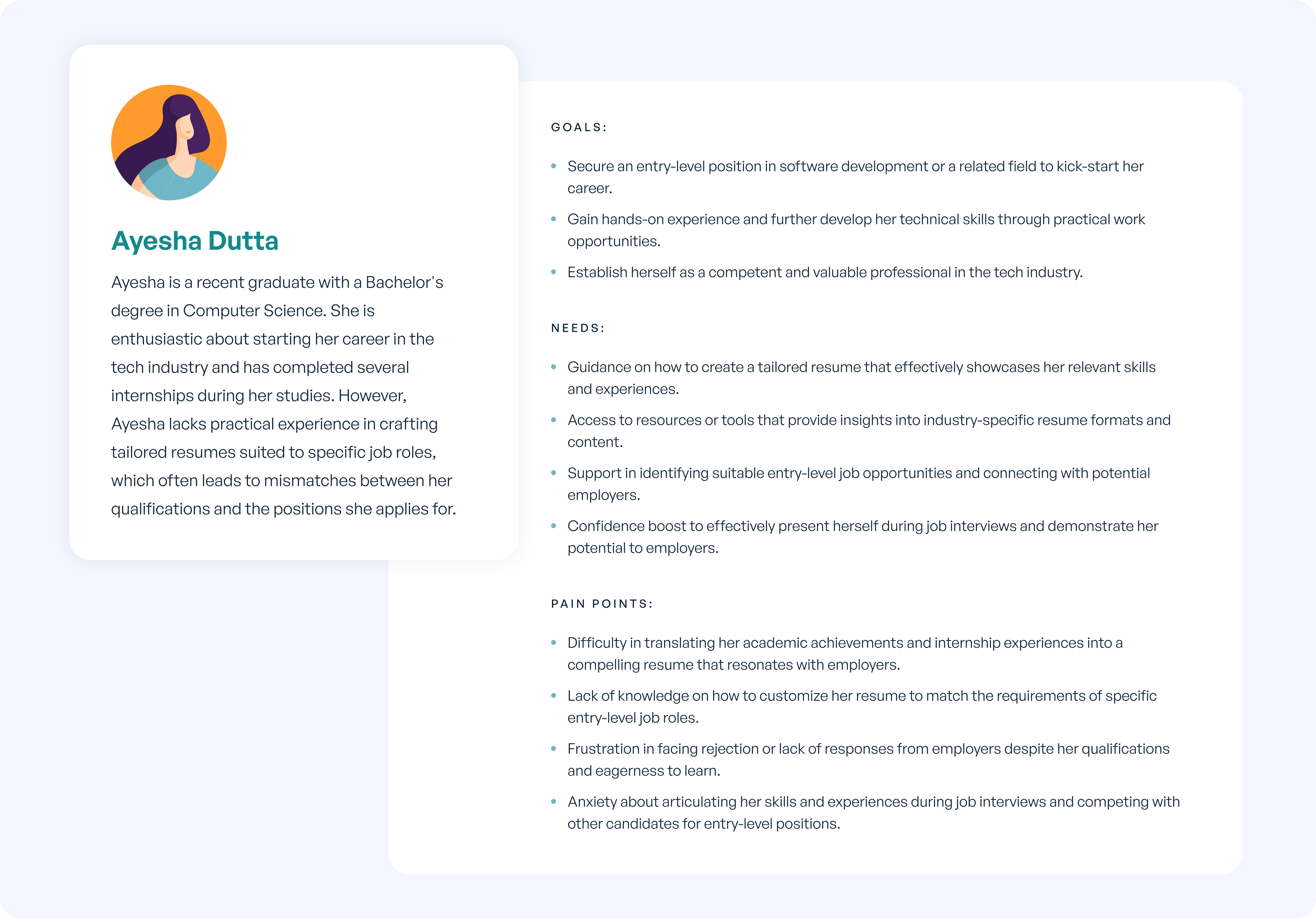
Candidates struggle to craft resumes that truly reflect who they are. Many don’t know what makes a strong resume or how to express their expertise effectively.
Most use the same version across every job, without tailoring it to the specific role they’re applying for

As a result, great talent often gets overlooked because their skills aren’t showcased the right way. Every rejection feels personal, even when the real problem lies in representation, not capability.
How might we design a tool which empower our candidates by showcasing their skills well and help the recruiters by making them spend less time finding the best fit, while making it simple, delightful and uncomplicated to use?
WHat we learned
Understanding Users
Let's see what users have to say?
Candidates:
To understand the pain points of the candidates, we talked to multiple candidates and below were the statements they gave:
"I struggle with presenting my experiences in a way that resonates with potential employers, making it difficult to stand out among other candidates.

Vividh Vivek Raj (SDE, Blance)
"Understanding what employers want and showcasing it on my resume is a challenge.

Shivani Mehta (B.Tech, Dayanand Sagar Institutions)
"I find it hard to highlight the right skills on my resume, so I often feel like I'm missing out on job opportunities that could be a good fit.

Kumuda Mulgund (SDE1, Blinkit)
Now let's look at the recruiter's side.
To understand the the perspective of recruiters, we talked to multiple recruiters asking:

Insights we got from all the talking:
The guiding direction
Objective

To help candidates craft tailored resumes for specific roles. By empowering candidates to accurately represent their qualifications and experiences, we aim to increase their chances of securing suitable employment opportunities.
To create a resume where recruiters have to spend much lesser time and get the maximum amount of information which helps in decision making and they end up finding the best fit candidate for the job role.
Goals
What are users expecting out of the new resume?
Company Side
  • Should be easy to scan through.
  • Should have enough information for decision making.
  • If recruiters forward the resume to the HM team, it should most likely be accepted by the HM team.
  • Reduce the time of scanning data compared to how much time they spend today.
  • If Geektrust is promising for screening and first round of interview, the screening and interview report should be elaborate so it's easy to understand how the candidate performed.
Candidate Side
  • Represents their skills and expertise well.
  • Can be customisable for different job roles they apply to.
  • Remove any bias based on pedigree colleges/previous organisations etc.
  • Doesn't take away their personality since it's created by someone else.
  • Shouldn't look too different from a traditional resume so that the essence of a resume is maintained.
How we approached it
Shaping the solution
Looking at the insights and what we wanted to achieve, we thought of building a resume with the below features:

Overview– Setting the stage
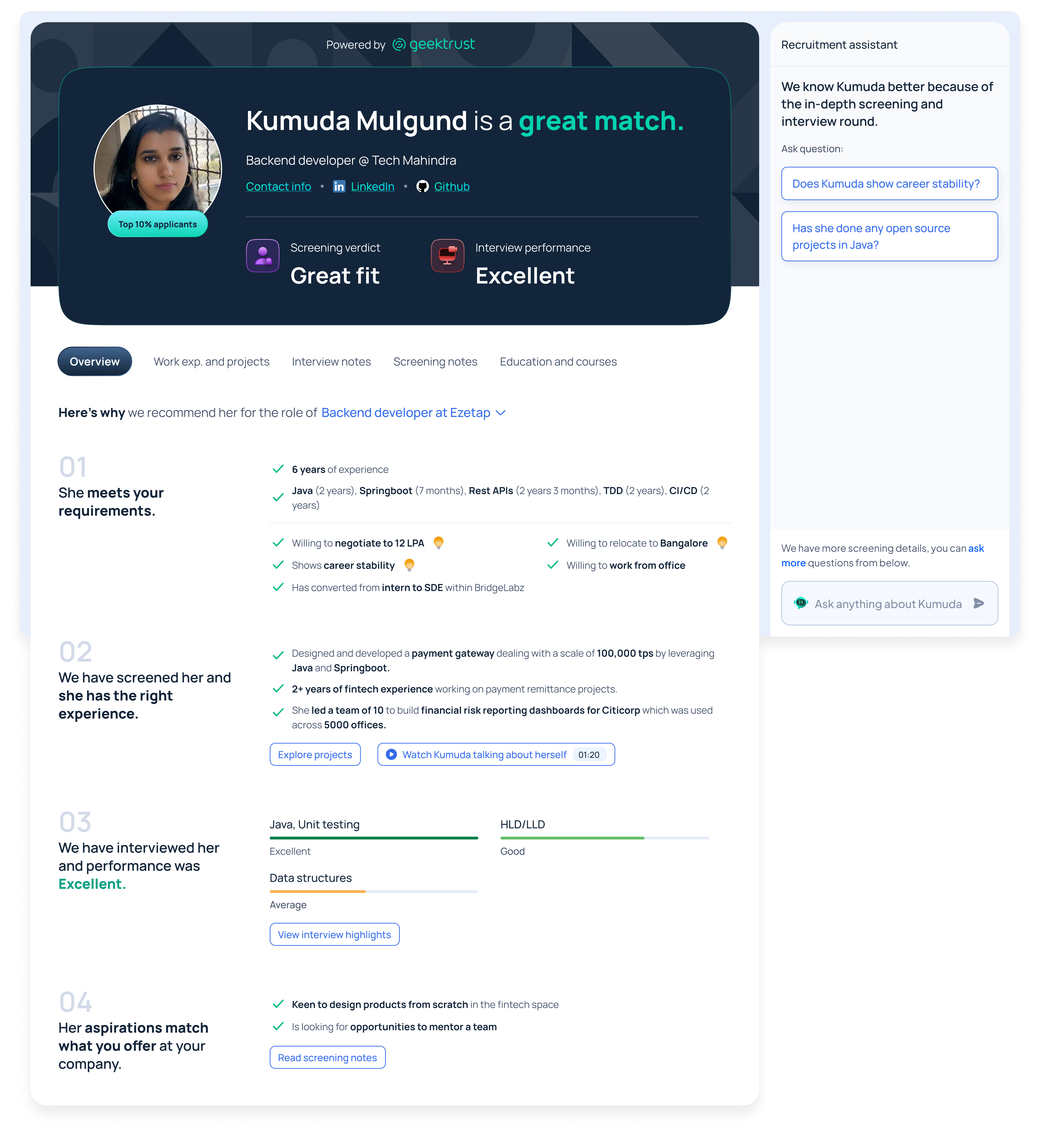
We started with an Overview section — a quick snapshot of a candidate’s profile so recruiters grasp the fit in seconds instead of minutes.
Matching parameter– The clarity check
Next, we introduced a Matching Parameter that instantly highlights how well a profile aligns with the role — bringing objectivity to the first impression.
Screening report– Building trust
We integrated Geektrust’s Screening Report to show verified coding results upfront, replacing guesswork with real skill insights.
Interview report– Going beyond the resume
The Interview Report connects performance data from live interviews, giving recruiters a transparent view of real abilities.
Chat feature– Keeping it human
And to make it conversational, we added a Chat Feature where recruiters can ask follow-up questions right from the resume — keeping the process transparent and persona
Exploring possibilities
Concept Creation
We need to design a resume with a summary section which should have a screening report, an interview report and a chat feature. So, I came up with this. :P
Feedback received:
After multiple discussions and brainstorming sessions with the internal team, we landed on the final design.
Iterations:
After multiple discussions and brainstorming sessions with the internal team of designers, developers and recruiters; the design went with  20+ iterations (600+ screens), and we finalised on a version.
Bringing it to life
Design- Version 1
Let's cut to the chase and see what we ended up designing. I'll explain the concept behind everything we opted for.

     Breakdown of the design
As a team, we were confident about the design.
Let's test with the users and see if our confidence is broken or this works out for us?
What we discovered
User testing
After we were ready with out final version, we conducted user tests to see if the smart resume actually works.

☞ We start by introducing our AI-driven recruitment solutions and presenting a prototype for feedback.
☞ Users evaluate candidates using the Geektrust Smart Resume, sharing their thoughts and recommendations.
☞ Follow-up questions explore the Smart Resume's effectiveness and potential improvements.
☞ We conclude by requesting testimonials and anonymous feedback to refine our product.

Detailed structure of the user interview >>
So, did it work?
We conducted the test with 10 different users.

The insights have been categorised into 4 categories:
Key observations:
Users didn’t interact much with the chatbot.
Navigating through the smart resume was a bit challenging.
Expected all the important callouts upfront.
Adding voice of the candidate lit up their eyes. (Builds trust)
Liked the screening and interview transcript (Builds trust).
Confused about projects, skills and work experience.
Almost all of them ignored LHS and went straight to the RHS information. (Maybe because if color difference)
Really liked the amount of information in the smart resume (and the fact that they could explore more using chat).

Findings:
The concept really clicked.
But there were a lot of issues too. Below are the findings from the interviews:
The sense of overwhelm when they first land on smart resume.
Time taken to get a quick sense of whether the candidate is a match or not.
Lack of simplicity in presentation of data (projects, interview details etc).
The fact that no one realises the candidate is screened.
Lack of trust.
A recruiter has to search everywhere for obvious data.
The chat was unintuitive. How unintuitive it is to dig / discover more.
Matching the HMs expectations of how they evaluate each skill.
Refining what we built
Final Design- Version 2
Looking at the findings from user research, we tried to solve the problems by our design.
To achieve the same, below are the changes made to the design:

The left hand side and right hand side were swapped.

REASON:
Users were less interested in interacting with the chat.
Overview section was brought outside as a separate tab.

REASON:
The landing page was overloaded with information.
Work experience and projects information were combined.

REASON:
Users confused the projects section with work experience.
Chat was given less space & shifted to right.
‍‍
REASON:
Users hardly interacted with the chat. And they focussed on the data instead of the chat.
The chat section was changed to light theme.

REASON:
Users didn't focus on the chat (maybe because it was in dark theme).
Reasons why the candidate was shown in a prominent way.

REASON:
Users found it difficult to understand why candidate was a match.
Screening and interview performance was shown upfront.

REASON:
It was difficult to figure out that candidates were screened & interviewed.
Interview and screening notes were added as a part of the tab.

REASON:
It was difficult to figure out that candidates were screened & interviewed.
Measuring the impact
Outcomes
After multiple design iterations and user testing rounds, version 2 significantly improved both recruiter and candidate experiences. Here’s what we observed post-launch:

Smart Resume now helps recruiters focus on what truly matters: skills, performance, and potential not formatting.
Reflections and takeaways
Learnings
This project taught me that making hiring fair and clear isn’t just about design,  it’s about showing a candidate’s true potential in the right way. And even in an AI product, the ‘human touch’(voice recording of candidates in the resume)
adds a lot of value.

I learned how data and design together can tell a stronger story.

Most of all, I saw how small UX changes can build trust and make decisions faster.